Blight Town - ‘Nu Malaise’ EP Review

Nottingham alternative/math-rock outfit Blight Town return with ‘Nu Malaise’, their third EP and a compact four-song exploration of depression, self-loathing, uncertainty and grief. Built from jagged guitar lines, complex rhythms, melodic vocals and flashes of post-hardcore aggression, the release finds the five-piece using technical chaos not as decoration, but as a way of giving shape to emotions that rarely arrive in a straight line.
Blight Town have never sounded interested in taking the easy route. Their music thrives on sharp turns, intricate guitar work and rhythms that seem ready to pull the floor out from underneath you at any moment. On ‘Nu Malaise’, however, all that technical chaos serves something much more human. The EP is restless and unpredictable, but never without purpose. Its complexity does not exist simply to show what the band can play. Every sudden change in tempo, every heavy breakdown and every moment of restraint helps translate emotions that are rarely neat enough to fit into a conventional song structure.

Photo by @chen.capture
“Go Go Gadget Bulletproof Head!” opens the EP with exactly the kind of title that demands attention, but underneath its playful exterior is a song about trying to reclaim some joy while living through an increasingly exhausting world.
The guitar work remains intricate throughout, constantly twisting around the vocals without sacrificing the track’s energy. Its chorus feels like an invitation to temporarily loosen your grip: acknowledge that the world is deeply screwed up, lose your mind for a moment and allow yourself to feel something other than dread.
There is also a refusal to accept that our lives are already mapped out for us. The song seems to push back against the belief that the table has been set and our futures decided before we ever get a say. Even when life feels predetermined, there is still room to move, change direction and choose what happens next.
That message gives the opener an unexpected sense of optimism. It does not deny how ugly things can be. Instead, it argues that recognizing the ugliness does not mean surrendering to it.

Photo by @chen.capture
The title track takes a far darker turn.
“Malaise” describes a vague sense of depression, discomfort, fatigue or general unease, but Blight Town gives that feeling teeth. “Nu Malaise” captures the exhaustion of someone who knows they need to get better but no longer believes they are worth saving.
Its recurring image of a dog being sent to the pound is especially brutal. The song tells a tale of someone who feels old, slow and disposable; something that has become too difficult to care for and would be easier to abandon. The pound can be read as a place where someone is sent to recover or be rescued, but the narrator does not want another chance. They are too tired to imagine that rescue leading anywhere.
Yet a small instinct for survival remains. The song describes a need to clear the poison from the mind and shed another layer of calloused skin. A callus protects what is underneath, but it also represents something hardened and numb. Removing it means tearing down the emotional defenses built during a depressive period and exposing something softer beneath them.
That softness may be necessary for healing, but vulnerability can feel terrifying when those defenses are the only things holding you together.
Musically, the breakdown between the second verse and bridge gives that conflict somewhere to erupt. Then the outro delivers one of the EP’s most memorable images, comparing the narrator’s life to a toaster in the bath. It is bleak, absurd and darkly funny; the kind of line that makes you laugh before its actual meaning settles in.
That balance between humor and despair is one of the reasons “Nu Malaise” stands as the EP’s strongest track. It is emotionally heavy without becoming humorless, symbolic without becoming inaccessible and technically involved without distracting from the story being told.

Photo by @willow.photo_
“World Speed Ravine” may not make as immediate an impression, but its construction becomes more rewarding as it unfolds.
The song begins with a lighter, groovier feel before gradually slipping into something more unstable. Its guitars remain complex, but the most compelling element is how the track changes alongside the narrator’s deteriorating mental state.
By the later verses, time and reality have begun to blur. Days and dates stop making sense, while the mind becomes trapped in a cycle of obsessive thought and self-loathing. The world outside may still contain something good, but the narrator can no longer recognize it from inside the spiral.
The musical shift leading into the final verse makes that descent feel almost physical. After the invitation to watch the narrator’s brain unravel, the track becomes heavier and more chaotic, collapsing into a breakdown that parallels the despair taking over.
That ending does not feel like heaviness included for its own sake. It is the natural consequence of everything preceding it. As the narrator sinks further into their thoughts, the music follows them down.
Even as the least immediate of the four tracks for me personally, “World Speed Ravine” remains an important part of the EP. Its melodic evolution demonstrates how well Blight Town can use composition to communicate an internal experience. The song does not merely tell us that someone is spiraling, rather, it begins to spiral with them.

Photo by @chen.capture
Then comes “Called2Say,” the EP’s longest, softest and most emotionally exposed song.
Where the previous tracks are filled with jagged movement, “Called2Say” creates space. Its nearly whispered vocals make the track feel private, like a conversation we were never supposed to hear. It carries the shape of a love song, but one addressed to someone who is no longer there.
“Without you, the world is unkind” establishes the song’s grief with painful simplicity. Losing someone does not only leave an empty space in your life. It changes the way everything around you feels. The world becomes harder because the person who once made it easier to survive is gone.
From there, the song confronts the uncertainty waiting on the other side of death. It wonders whether doubting the afterlife might prevent someone from reaching it, capturing the tension between skepticism and the desperate hope that separation is temporary.
That question is not really about theology. It is about wanting reassurance that a meaningful connection cannot simply vanish.
The alternative is much colder: perhaps death only returns us to the earth, where our bodies decompose and help something else grow. There is beauty in that image, but also terror. Becoming part of new life is not the same as being reunited with the people we love.
Even believing in a reunion does not erase the pain. The real cruelty is the wait; the years, decades or entire lifetime that may separate one person’s death from another’s. Sometimes continuing to live with the absence can feel harder than the original moment of loss.
The song also understands that speaking to the dead is not exclusive to religion. Someone may never pray in the traditional sense and still talk to the people they have lost. We ask them for guidance. We tell them about our lives. We imagine what advice they might give us when everything feels impossible.
“Called2Say” frames those conversations as voicemails sent out into an endless blue: messages delivered with love despite knowing no answer will come. It is a devastatingly effective metaphor because a voicemail normally carries the possibility of a return call. Grief turns it into a permanently one-sided exchange.
The instrumental passage near the end allows all that restrained emotion to finally swell beyond language. After spending much of the song speaking quietly, the music takes over and says what the narrator cannot.
As the EP’s closing track, “Called2Say” does not offer a clean resolution. It leaves the listener suspended in that unanswered conversation, still reaching toward someone who can no longer reach back.
That lack of resolution feels appropriate for Nu Malaise. Depression does not disappear because we understand it. Grief does not end because we have found the right metaphor. A mental spiral does not always arrive at a lesson.
What Blight Town offers instead is recognition.
These songs acknowledge the strange ways people survive: letting loose while the world burns, hiding beneath hardened emotional skin, watching our thoughts turn against us and continuing to speak to people we know cannot answer. The EP is heavy, but its weight comes from more than distorted guitars and breakdowns. It comes from the honesty beneath them.
Nu Malaise may only contain four songs, but there is no wasted space. Each track reveals another side of emotional exhaustion while showing just how effectively Blight Town can combine math-rock intricacy, post-hardcore intensity and genuine vulnerability.
The result is an EP that feels chaotic because life is chaotic, bleak because loss is bleak and occasionally funny because sometimes laughing at the darkness is the only way to keep it from swallowing you whole.
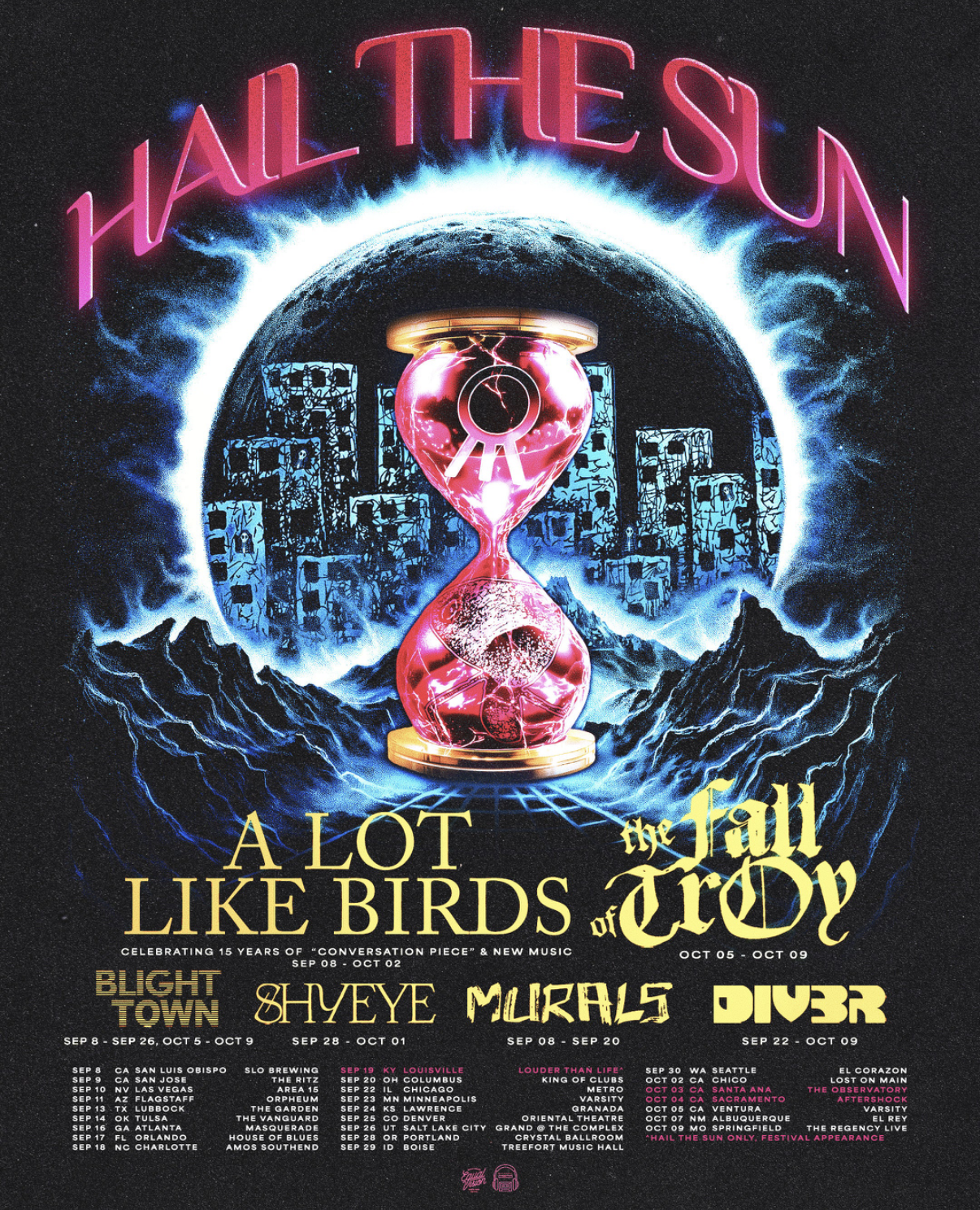
Blight Town will bring Nu Malaise across North America this fall as support for Hail the Sun’s Cut. Tour. Fade. Back. Part Two. The band will appear on the September 8–26 stretch, before returning for the October 5–9 dates. Be sure to follow their journey on instagram too at, @blighttownuk and catch them live on tour this year in the US!